

Turn to Page 51
I was not a reader.
Ask anyone who knew me as a kid. Books were something that happened to other people. Then someone handed me a Choose Your Own Adventure book and something shifted.
It wasn’t the story. It was the format. Every few pages, the book stopped and looked at you. What do you do next? You had to decide. You had to show up, or the story stopped cold in your hands.
That was the first time I felt the difference between consuming something and participating in it.
Then I grew up. And for a long time, I went back to consuming.
Not wasted time. That matters. I was doing something. I just didn’t have a name for it yet. I was marking sentences. Pausing on words that grabbed me. Noting moments where someone else’s words pointed at something I already felt but couldn’t articulate. That first pause, that instinct to mark something, was the initial turn. From pure receiver toward something else.
But the ideas were going somewhere to die.
Others have named this before me. Todd Henry built an entire book around the idea that the most valuable land in the world is the graveyard, buried with unwritten novels, unlaunched businesses, unfinished things. Tiago Forte called it more specifically what I had built: an idea graveyard. Notes and captures are collecting dust instead of going to work. The ideas weren’t gone. They just weren’t easily seen.
That’s exactly where I was.
Handwritten notebooks. Journals. Evernote. Notion. Obsidian. One system after another, each one a container that held the ideas but couldn’t connect them. The highlights accumulated. The captures piled up. Like knowing you know something but not being able to reach it. The ingredients were there. Nobody was cooking.
I wasn’t the first person to notice the problem.
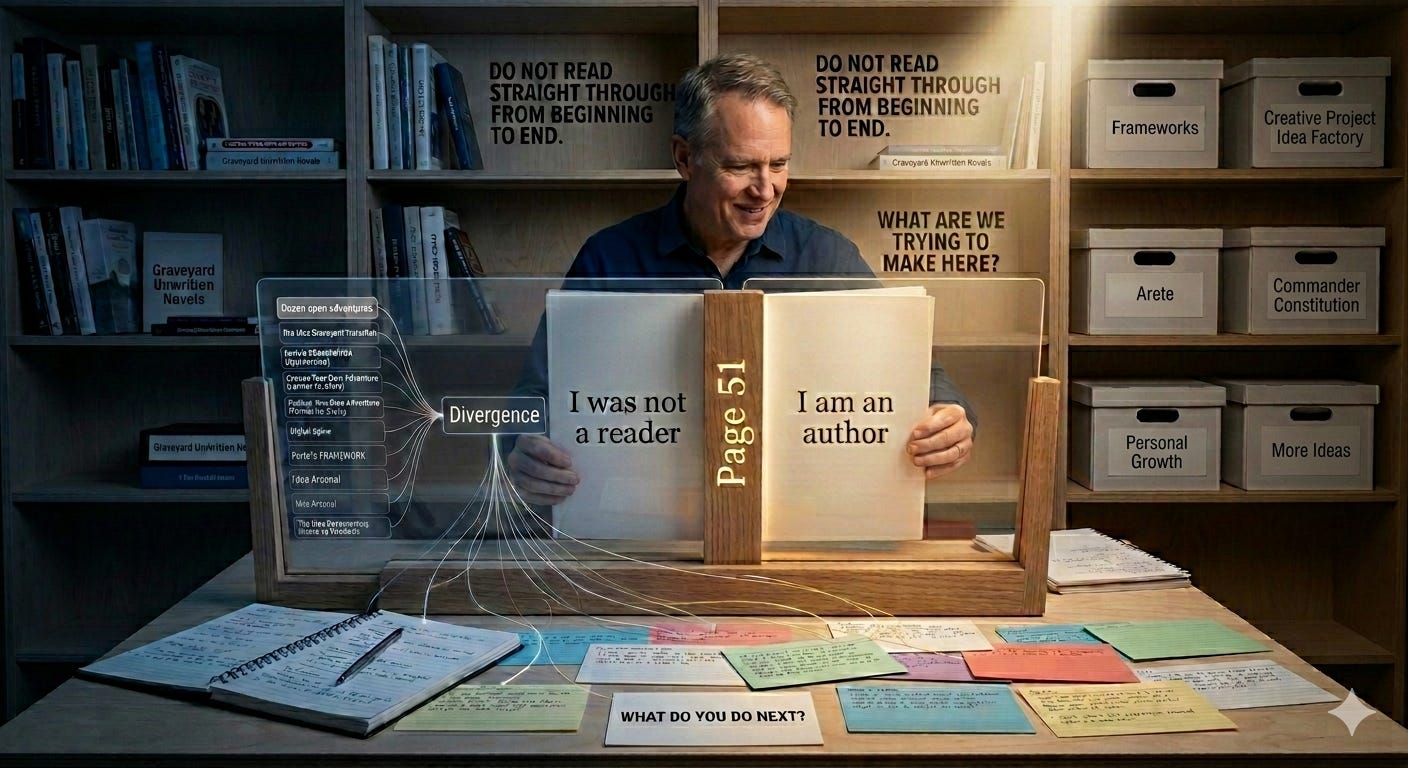
Ryan Holiday spreads index cards across the floor. Every idea from every book is laid out where he can see it all at once. That’s his system. It works for him. Mine has always been digital. Notebooks gave way to Evernote, Evernote to Notion, Notion to Obsidian, and now to something that does what none of those could.
Tiago Forte built a framework around the same instinct: Capture, Organize, Distill, Express. The insight I kept circling without landing: you have to be able to see your thoughts before you can do anything with them.
The puzzle pieces have to be on the table. And you start with the edges, not because the edges are the most interesting part, but because they set the boundary. They answer the first question before all the others: What are we trying to make here?
That question is what the older tools were missing. Not the storage. The direction.
I glanced left this morning at the Claude sidebar. At first glance, it looks like every other interface I’ve used: Evernote, Notion, and Obsidian. A list. A collection. More captured things waiting in a column.
But it isn’t that.
Each item in that list is a conversation. Not a note I left somewhere. A thread I started and can walk back into. Dozens of open adventures. Each one a page I chose to turn to, each one connected to the others by a thread I didn’t put there consciously but can now see.
These are conversations. Alive. Returnable. And when I come back to one that’s been sitting for months, I don’t just retrieve it. I re-enter it. The idea gets refined by two things: the tool, and the version of me that came back to it.
Each thread is its own adventure. Or it’s a choice point in a larger one. The sidebar doesn’t force the distinction. You do. You decide what you’re making.
Most people want a map with one X. A single destination. A guaranteed route. That’s the wrong question. Every expedition forward opens doors that weren’t visible from where you started. The real treasure isn’t the answer at the end. It’s the expansion of what becomes possible.
Every choice branches. Every page leads somewhere different. But it’s still one book. One spine holding all the possible adventures together.
This is my spine. Weeks of posts. Dozens of sessions. One story being written across all of them. By a kid who wasn’t a reader, who spent decades gathering material he didn’t know was his, who finally found a format that asked him to participate again.
The tool can make the choices for you. It can hand you a story that feels like yours without asking anything of you. You can keep your finger on the previous page, test the next one without committing, and never actually arrive anywhere. That danger is real. It deserves its own conversation.
But that’s not what this is.
The book that found me at eight years old had one instruction before the story began.
Do not read straight through from beginning to end.
Same instruction. Different decade.
Page 51 is where I stopped being the reader and started being the author. The adventure didn’t begin there. But that’s where I finally knew I was in one.
You’ve been collecting pages, too. Maybe for years. Maybe without knowing that’s what you were doing.
So here’s the question the book always asked:
What do you do next?