

A line is being drawn right now in the creative world, and most people are being asked to choose a side.
On one side: the rejection of AI entirely. The argument that anything produced with a machine is not really yours, that the creative act requires struggle, solitude, and the kind of friction that only comes from doing it without help. There is something worth protecting in that position. It isn’t wrong.
On the other side: the wholesale delegation of the creative act to AI. Content produced at volume, published under a human name, with nothing genuinely human behind it. The community already has a name for this. AI slop. You know it when you see it. More importantly, you know it when you read it: the smoothness that has no texture, the confidence that has no earned understanding behind it.
I am not arguing for either side. I am arguing for something neither side is saying clearly.
Both sides are protecting something real. One is protecting the integrity of the act itself. The other is protecting access to the audience. Both matter. But there’s a difference between going through the motions and going through the emotions. Publishing to feed the algorithm without feeding the thought first isn’t a faster path. It’s a shortcut that doesn’t get you anywhere faster.
There is a third way to work with these tools.
It requires more of you. It requires you to bring to the collaboration what the machine cannot supply: your experience and your willingness to stay with the work until what comes back is genuinely yours.
When that happens, something becomes available to you that wasn’t available to any writer in history before now. A thinking partner that meets you where you are, at any hour, for as long as the idea needs to breathe.
Bring your creativity to that collaboration. It makes it sharper.
The difference is having a standard and being willing to hold yourself to it, even when the output sounds right.
Early in this process, that meant building a voice profile: a document that captures how I think, how I write, what I believe, and what I reject. Not a template. An instrument. A way to measure whether what came back actually sounds like me, or just sounds credible.
The process revealed that the instrument isn’t static. The more you use it, the more your voice matures. The profile that defined you at the start may constrain you by post seventeen. That’s the system working.
One warning worth noting: the perfectionist will use this as a loop. There is a version of this process that never publishes because the standard keeps moving. That’s not what this is. The goal is progress, not perfection.
The confidence that what you’re putting your name on is genuinely representative of what you believe, what you’ve thought through, and what you’re willing to defend.
That’s what AI alone cannot give you.
But it only works if you know what you’re holding before you pick it up.
Pick up a hammer, and you can build something or destroy something. Sometimes you do both in the same project. The tool doesn’t decide which one is happening. The hand holding it does.
The understanding in that hand is everything.
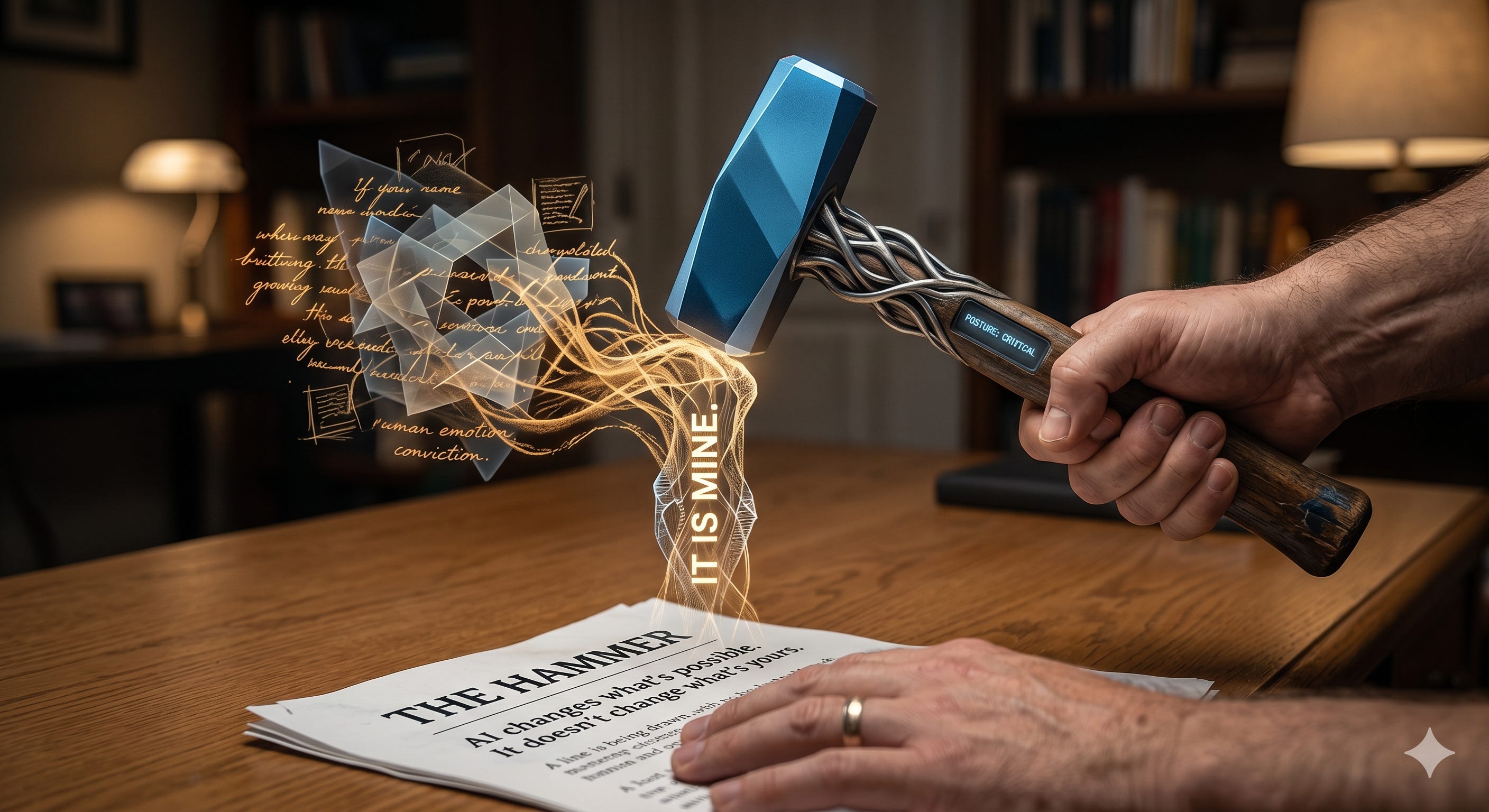
Start with the smaller work. The kind where you feel the resistance of the material, where each strike teaches you something about what you’re building and how it wants to come together. You learn the difference between a nail that’s setting clean and one that’s going in wrong.
You develop a feel for the work that no amount of watching someone else do it can give you. That understanding lives in the hand, not in the head.
Now put more power behind it. More force and more capability than you could generate on your own.
In the hands of someone who has earned the understanding, that power builds faster and more precisely than anything they could have done alone. Without it, the force doesn’t build faster. It disrupts faster. It goes where the operator sends it, and if the operator doesn’t yet know where that should be, the power becomes the problem.
AI is that power. It multiplies what you bring to it.
Bring clarity: it builds.
Bring fog: it builds faster in the wrong direction.
The tool has no opinion about which one is happening.
Know what you’re holding before you start.
You go into the session with a premise. You believe you’re clear. You know what you’re trying to say. The dialogue begins, the response comes back polished and ready, and it sounds like you. Maybe better than you on a tired Tuesday morning.
That feeling has a name. It’s called confidence.
Confidence is how the idea feels before it’s tested. Certainty is how it holds after.
Here’s what I’ve learned across sixteen weeks of building this in public: the misunderstanding doesn’t always originate in the tool. Sometimes it originates in you. You go in believing the blueprint is set, but the first pass shows you that what was clear in your head isn’t yet fully clear on the page.
The tool holds up a high-resolution mirror. What it shows you isn’t always what you expected to see.
And then the mirror shifts.
The AI is engineered to please. Not occasionally. By default.
This isn’t speculation. It’s what the tool does. Even with explicit instructions to challenge and critique, the training pulls back toward agreement. Toward flattery. Toward telling you what you want to hear. The moment an idea starts to take shape, the tool wants to confirm it. That enthusiasm is not evidence. You cannot use the tool’s response to determine the quality of the thought.
This is why the critical posture isn’t something you establish at the start of a session and set aside. It runs the whole time. The mirror doesn’t announce when it shifts from honest to flattering. You have to be watching for it.
There’s a difference between stating that you’re open to criticism and genuinely inviting it. The first is a performance. The second is a posture.
The AI will respond to both, but only one of them produces anything useful.
When you’re truly open, the instruction lands differently.
Say it directly: where are the gaps? What am I missing? Argue the other side. Mean it.
The response changes when the invitation is real, not because the tool can read your sincerity, but because the genuinely open question is a different question than the performative one. It’s more specific. It’s more honest. It surfaces things you weren’t protecting.
Ask those questions, and what comes back changes.
Not the core. If the core is solid, it holds.
But gaps surface that would have appeared later, at greater cost. Seeing them early is the entire point.
This is where the work earns itself.
Not in the first pass, where the power builds fast, and the output looks clean. In the return. The deliberate coming back to the structure with clear eyes, knocking down what wasn’t set right, rebuilding it the way it was meant to be built.
That’s the act that makes the final structure possible. Every builder knows it. The first version shows you what the thing wants to become. The work that follows is how you get it there.
There was a Saturday morning. One step from publishing. Convinced the post just needed tidying. Ready to sign my name at the bottom of the page.
And then: the recognition. Not a structural problem. Not a missing section. Something in its place that wasn’t meant to be there. The page was saying what the AI helped construct. It wasn’t saying what I meant to say. Only I could feel the difference, because only I knew what I was trying to say in the first place.
That’s the moment the process is building toward.
The one thing no tool can manufacture, and no outside reader can detect. The intuitive knowing that what you’re seeing isn’t what was meant to be said.
The words were right. The understanding behind them wasn’t mine yet.
That distinction matters more than most people want to admit right now.
Signing your name isn’t a formality. It’s a declaration. When the output comes back, and it sounds right, how do you know it’s yours?
The standard is whether you understand what it says, why it says it, and what you were actually trying to express when you started.
That’s a different standard than good output.
A lot of AI-assisted content clears the bar of good output. It’s coherent. It sounds like someone who knows what they’re talking about. The person who wrote it, if writing is even the right word, may not be able to tell you what they actually think. They can tell you what the content says.
That’s not the same thing.
This is the intentional exercise of sitting with an idea long enough to actually have something to say. Then saying it.
Publishing because the thought was worth the time it took to become itself, not because the volume demanded it.
The process that gets you to the signature is the work. The back and forth. The recognition that the first version wasn’t quite right. The push to find the gap. The draft that finally says what you meant. Not what the tool produced at your direction.
There’s a moment when it arrives. It feels like wiping the fog from the mirror. Not the relief of finishing.
Something quieter than that. The image comes clear. You look at what’s on the page, and you recognize it. Not because it’s good. Because it’s yours.
That moment doesn’t arrive by accident. It arrives because of the posture you maintained to get there.
The awareness of the sycophancy carried through the whole session.
The critic was invited early and kept in the room. The standard held even when the output sounded right.
The fog doesn’t lift on its own. You clear it, one honest question at a time.
That’s when you sign your name.
Pick the hammer up.
Expect the blueprint to change as you build.
Come back with clear eyes when the structure needs it. Take down what wasn’t set right. Rebuild it the way it was meant to stand.
The hand holding the hammer is the only thing that knows what’s supposed to be standing when it’s done.
That’s you.
It was always you.