

My name is David.
There is a story about a block of marble that sat rejected for twenty-five years. Other sculptors looked at it and walked away. Too damaged. Too difficult. Not worth the effort. What they saw was the flaw. What they missed was everything else.
It took a different kind of seeing.
Michelangelo looked at the same imperfect surface and saw what was inside it. He once said the sculpture already existed within the marble. His job was simply to remove everything that wasn’t David. Something handed him the chisel and said, This is yours. Start chipping.
I believe that force exists for all of us. It doesn’t wait for the right moment. It doesn’t wait until the surface looks ready. It looks at the raw, imperfect, passed-over material of who you are and sees what nobody else has bothered to look for. And at some point, in some form, it hands you a chisel.
For me, it showed up on a porch.
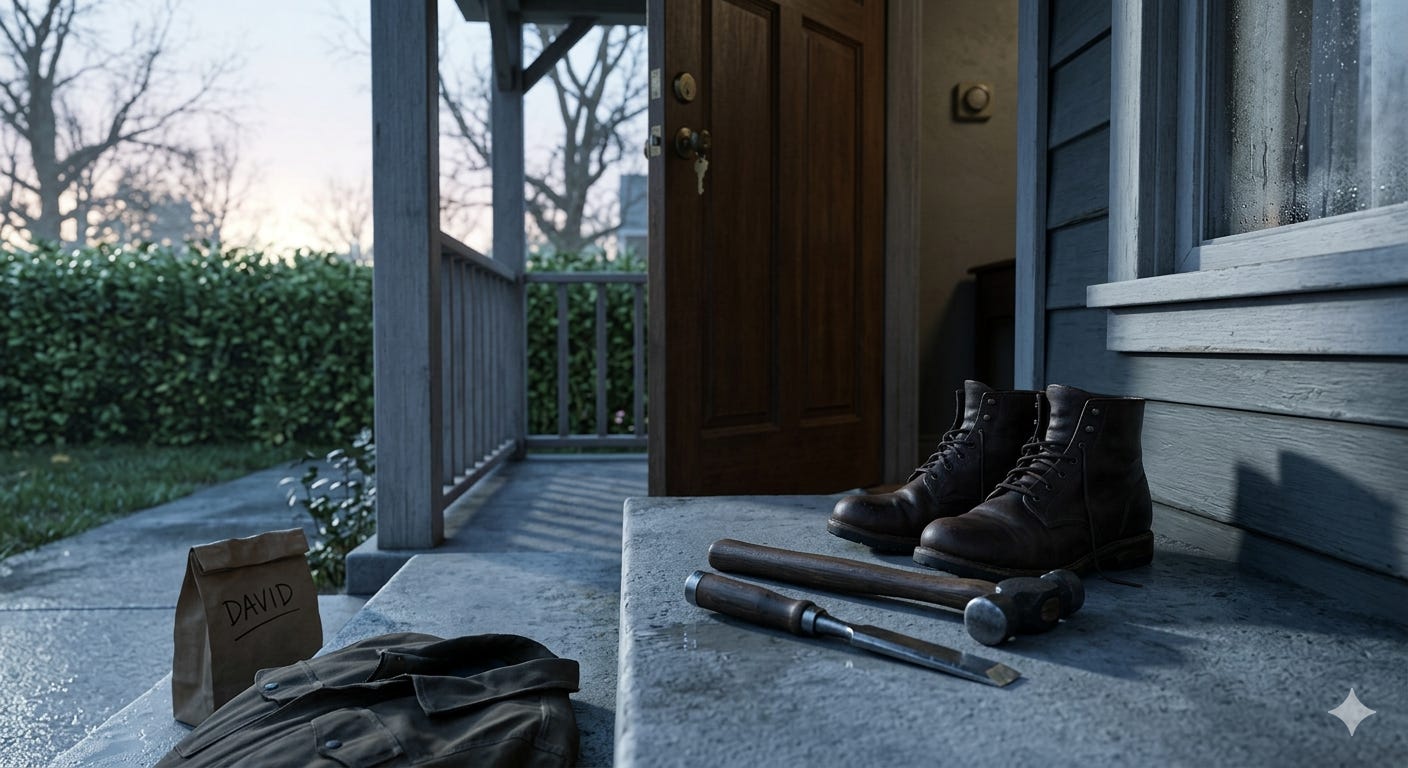
It was a morning like every other morning for the last twenty years. Coat on. Lunch in hand. Lock the door.
I’ve done this thousands of times. Same sequence, same order, same door. And somewhere between locking it and turning around, I caught myself narrating.
He walks down the stairs. He grabs his coat. He locks the door.
Third person. Present tense. Watching from outside the body.
I stopped. Stood at the threshold between the life I was living and the one waiting on the other side of it. Let out a breath I didn’t know I was holding.
That silence was significant. It was the moment a pattern recognized itself.
Something calling the play-by-play of a morning so deeply grooved it had become invisible.And doing it in a voice that was done pretending this was enough. I’m fairly certain that was my higher self. It wasn’t impressed. And for the first time in a long time, neither was I.
Most of us are handed a script before we’re old enough to question it.
School. Grades. Job. Ladder.
You follow it because everyone around you is following it, because it carries the full weight of assumption, because nobody ever calls it what it actually is. Paul Millerd calls it the default path. That name hit me like a diagnosis I’d been waiting years to receive. Not because it told me something I didn’t know. Because it is named something I’d been living without words for.
Here’s the problem with the default path. It doesn’t treat the disease. It treats the symptoms. It hands you a prescription, routine, status, the comfort of knowing your role, just enough to manage the dis-ease of not being fully yourself. And for a while, it works. You stay functional.
You stay compliant.
But the body builds tolerance.
The dose that numbed you in year one barely registers by year ten. The routine deepens. The ritual solidifies. Down the stairs. Coat on. Lock the door.
You’ve been taking this medicine so long that it’s just part of what you do. Underneath it, untreated, the real condition remains. The growing distance between who you are and what you do. A hairline fracture forming slowly, invisibly, in the dark.
The default path hides itself well because you’re surrounded by people on the same prescription. Everyone is managing the same symptoms, and nobody is questioning it because nobody has to.
Disillusionment becomes personality. Dissociation becomes professionalism. Doing the work for someone else becomes just the way it is.
Nobody calls it a trap. Nobody calls it a maze.
They call it Monday.
The porch is where tolerance breaks. Where the symptoms push through the prescription loud enough for something else to show up. Something that looks at the marble the way Michelangelo did. Not with disappointment. With recognition. Seeing what’s been inside all along and handing you the chisel again.
That’s not a breakdown. That’s the call.
Herminia Ibarra spent years studying people who changed careers and found they all shared one thing. They didn’t think their way into a new identity. They removed what wasn’t them until what remained was undeniable. One reluctant yes at a time.
Fifteen years ago, something started pulling me out of bed before the world woke up toward a quiet I couldn’t explain and didn’t know I needed.
Meditation first. My first reaction was resistance. Who do you think you are? Some kind of enlightened yogi? Then I did it anyway. Something shifted. Not enlightenment. Just clarity. Enough to say: I’m not a yogi. I’m just a guy who needs this.
Next, journaling. Resisted that for years.
Reading. I told myself I wasn’t a reader.
That wasn’t who I was.
I was wrong about all of it. And the only way I found out was by doing it anyway.
Every reluctant yes was a tap of the chisel. Every practice I resisted before I embraced it removed something that wasn’t me and revealed something that was. The path wasn’t being planned. It was being carved. One pre-dawn hour at a time, one book, one journal entry, one hard question at a time.
You don’t build tolerance to the chisel. Every tap reveals something new. The excavation compounds.
That’s the difference between the default path and the pathless path. One is a prescription you habituate to until it stops working. The other is the harder, slower, more honest treatment. The one that actually goes after the source.
Here’s the thing I’m learning about the pathless path.
You don’t decide to start it. You decide to admit you already have.
It began fifteen years ago in a quiet house before the world woke up. The narrator on the porch wasn’t announcing a beginning. It was proclaiming that the tolerance had expired. That the distance between who you are and what you do has finally run out.
The sculpture was always in the marble.
The chisel has been in your hand longer than you know.
The only question left is whether you’re willing to admit it.