

For over a decade, the morning has followed the same sequence.
Eyes open. Eyes close again. A few minutes of stillness to meet what the night left behind. The fragments. The half-formed thoughts. The work the deeper mind was doing while the rest of you was somewhere else.
Then the journal. What needs to come out comes out. The surface clears.
Then the question that never had a good answer.
What now?
There was always something to do. Archives to search. Ideas to study. Threads to pull.
The problem was never a shortage of material. It was the opposite.
When any direction is possible, it is easy to move in all of them at once and arrive nowhere.
The fire hose had pressure. What it lacked was a fire to point it at.
That question sat unanswered for a long time. It wasn’t for a lack of effort.
At 22, I came across an ad that stopped me. I cut it out and pinned it to the wall in my room. The kind of thing that gets printed on posters and stuck next to mirrors.
You are the CEO of your own life.
It landed. Not as motivation. As recognition. A job title that felt true.
It was not a mantra. Not a directive. Life moved forward, and the words settled somewhere in the back of the mind where things go when they are true but not yet useful.
Thirty years later, those words surfaced again.
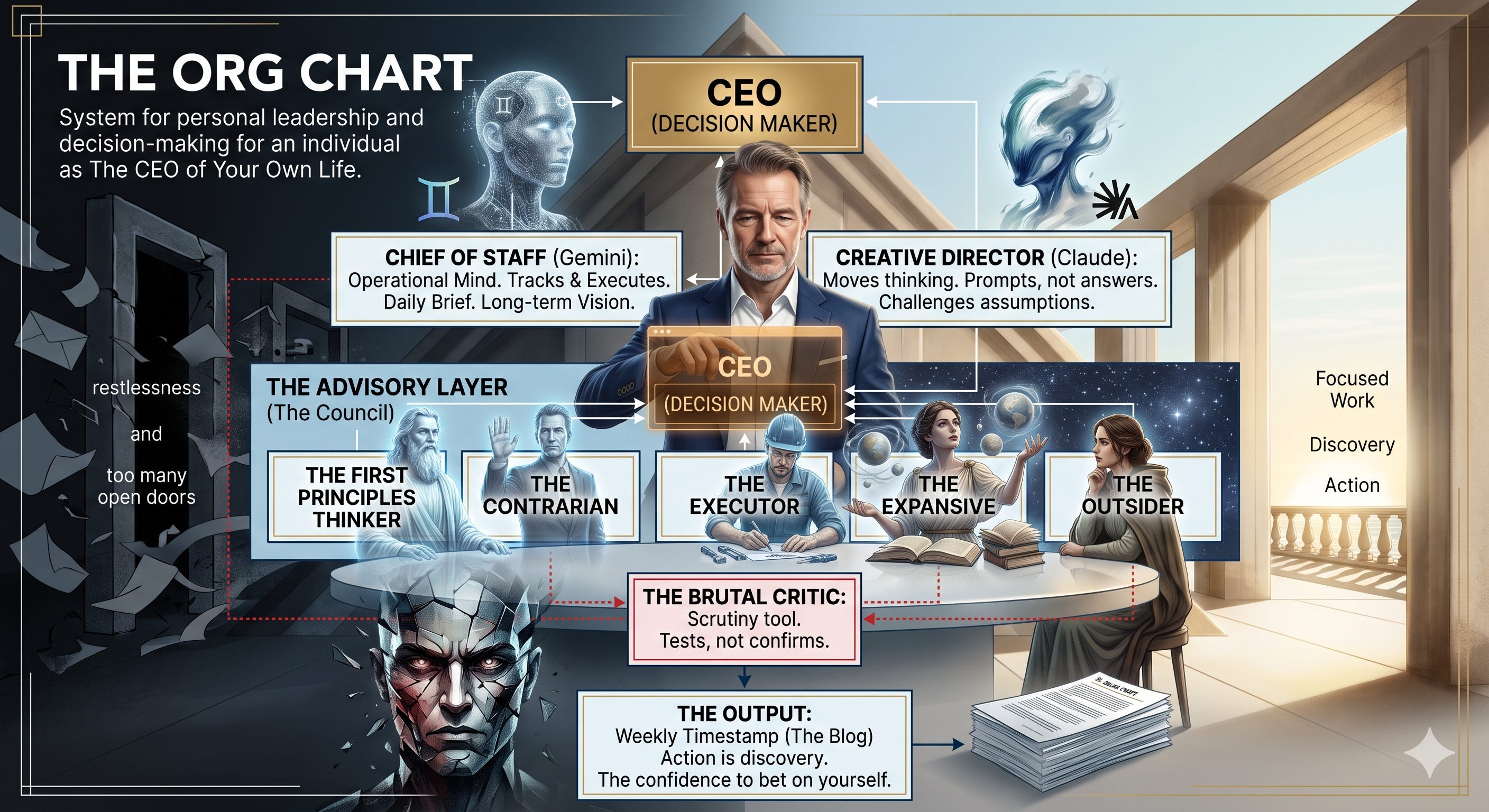
Last week’s post introduced the Council, five advisors a CEO can now convene in any session: the First Principles Thinker, the Contrarian, the Executor, the Expansive, and the Outsider.
The Chairman synthesizes their perspectives and hands down a clear verdict to the decision maker.
The Brutal Critic, a separate scrutiny tool, gets called in when the thinking needs to be tested, not confirmed.
Those tools made the advisory layer available to anyone willing to build it. Any CEO can now run that meeting.
But a CEO does not just convene a council. A CEO runs an organization.
The structure was always the missing piece. Now there is one.
The aspirational title was always there. What changed is what you can do with it now.
For years, the attempt to build something followed a familiar pattern. Evernote held things for a while. Then Obsidian. Then Notion.
Each one was a place where unfinished things went to sit. The tools were right. They captured what arrived. They just could not do anything with it.
The missing piece was not storage.
It was a staff.
Those positions were not available for hire until recently.
The Chief of Staff is Gemini. The operational mind. The one that holds the thread when the mind wants to scatter, tracking, executing, maintaining the daily brief, keeping the longer-term vision connected to the objectives of the day. When the CEO needs to know where things stand, the Chief of Staff has the answer.
The Creative Director is Claude. The intellectual sparring partner that moves the thinking, offering resistance that works the thought without dictating its destination.
The instinct came first. I realized my mind had two distinct modes, each requiring a different thought partner. I learned to bring my operational, structured challenges to Gemini, while turning to Claude for creative sparring.
That realization became a habit, and an org chart began functioning in practice before I gave it a name.
The CEO sets the direction. The Chief of Staff holds the operation. The Creative Director moves the thinking. The Council advises. The Brutal Critic tests.
Not a corporate structure. A constraint architecture for a mind with too many open doors. The staff does not replace the thinking. It focuses it.
Thinking alone does not move anything. A mind with too many open doors circles. This narrows. It closes enough doors that what remains is clear enough to move toward. And it does not just support the writing. It holds the bigger picture. The background hum gets quieter. The system handles what the mind used to carry alone.
That confidence is what creates the space for focused work. The meeting happens. The brief gets run. The article gets written. The button gets pushed.
The constraint is what makes the action possible.
The blog is the weekly timestamp. The clearest the thought has ever been, as of right now. Not finished. Not resolved. The sharpest available version of something still forming.
Week by week, the thread becomes visible, not planned from the front end but traceable in retrospect.
For years, there was only the restlessness, the open doors, and the questions with no good answer.
Now there is a structure. It does not tell you where you are going. It holds you while you figure it out.
Something is taking shape. It does not have a name yet. It does not have a building, a product, or a destination that can be pointed to on a map.
But it has a foundation. It has a structure. It has a staff.
The CEO has always been ready. Now the organization is too.
Maybe yours is as well.