

You know that moment when you hear something, you read something, and there’s a part of you that just knows but can’t quite understand how you know.
Those moments that stand out, that make you pause, and you’re not sure why. That pause is a highlight. Whether you mark it or not.
What happens next? Does it just disappear? Do you forget that feeling in that moment?
Then inevitably, as life does, the idea comes back around. This time you’re hearing it again, perhaps for the second or the third time. Do you make that connection? Do you feel compelled to explore more of the why behind the gut feeling?
At some point, the question stops being “why does this keep coming back?” and becomes something harder. What happens if I never do anything with it?
I highlight books. Always have. Maybe you dog-ear pages. Maybe you underline. Maybe you just pause a little longer than everyone else before turning the page. It’s not so much a system. Some of us just pay attention.
Joseph Campbell was once asked by Alan Watts what spiritual practice he followed. His answer: “I underline books. It’s all in how you approach it.”
That landed the first time I read it. It lands harder every time it comes back.
Because paying attention to what stops you is not a reading habit. That’s a practice.
Here’s what I’ve noticed. A highlight doesn’t come back once. It comes back in waves.
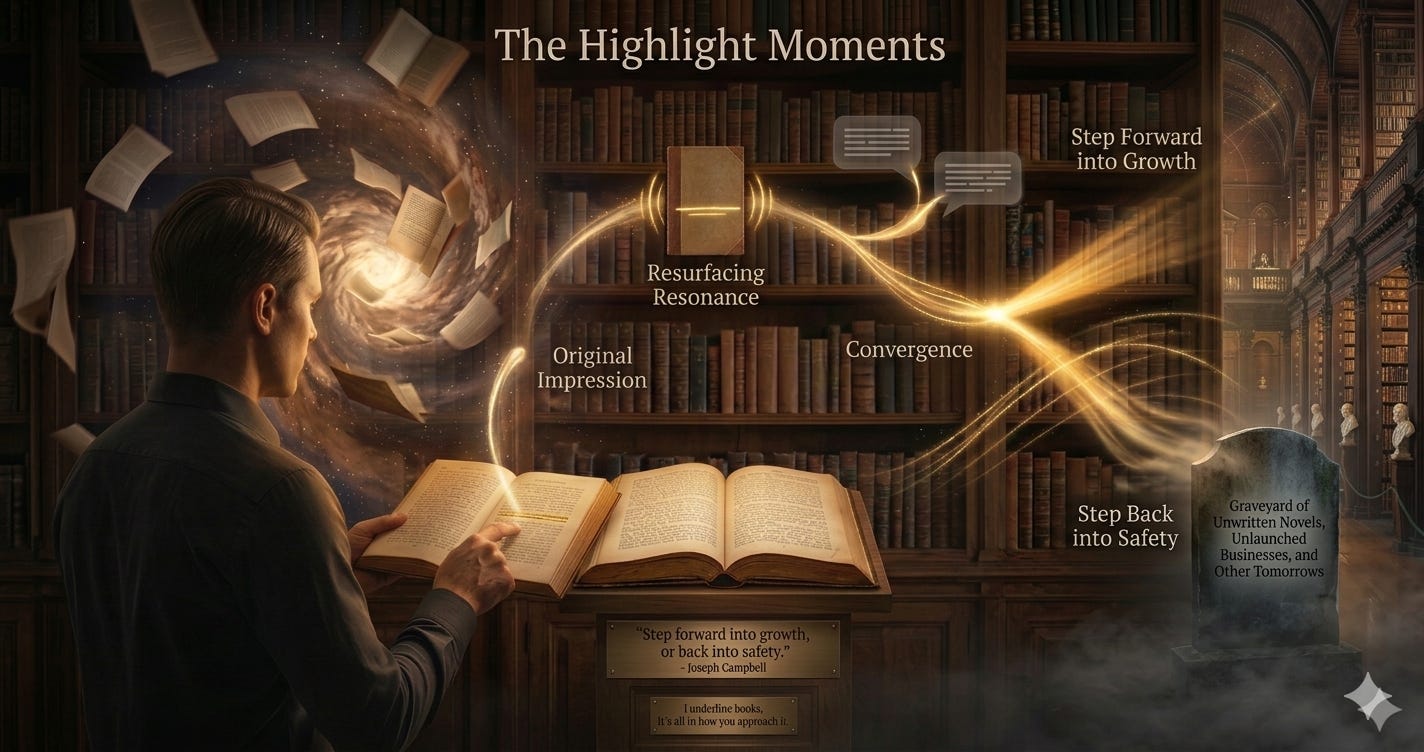
First, the original impression. The moment something stopped you cold. Then the resurfacing. Weeks or months later, the same words, the same pause. Then the convergence. A completely different voice, a different book, a different conversation, arriving at the same truth from a different direction.
Original impression. Resurfacing resonance. Convergence.
Sound familiar? You’ve been doing this longer than you think.
That’s when you know it’s yours. That’s when it’s ready.
Todd Henry, who spent a career studying what happens to people who never act on their best work, warned us about the graveyard. His words, not mine: “The most valuable land in the world is the graveyard. In the graveyard are buried all of the unwritten novels, never-launched businesses, unreconciled relationships, and all of the other things that people thought, ‘I’ll get around to that tomorrow.’”
One day, however, their tomorrows ran out.
It hurts to think about. It’s supposed to.
Brian Johnson, in his exploration of what it means to live heroically, points to Michelangelo’s David. Most people assume the statue captures the moment of victory.
Goliath defeated. Hero made.
It doesn’t. Michelangelo captured the moment before. The moment of decision. The moment David chose to step forward instead of back.
That’s the moment. That’s always the moment. And it’s the same moment you’re in every time a pause returns and asks you what you’re going to do with it this time.
Joseph Campbell, who spent a lifetime mapping the hero’s journey across every culture on earth, named it simply: step forward into growth, or back into safety.
Every time a highlight resurfaces and stops you again, that’s the moment you’re in. Not the writing. Not the conversation. The decision, right there, in the pause, whether to carry the idea forward or let it go back into the ground.
For me, the first step was simpler than I realized. I started bringing these ideas into conversation with the people closest to me. Informally. Naturally. Without knowing, I was already practicing something.
Now the circle is wider. You’re in it.
When the inevitable next moment arrives, and it will, someone else will say the same thing. A different source. A different voice. The same truth.
Something in you recognized it before your mind caught up.
Life isn’t just nudging you to read something or hear something.
It’s nudging you to do something.