

Choosing is one thing. Living the choice, every morning, before anyone else is awake, to question it. That’s another.
Most people in my life have never understood why I keep the hours I keep and do the things I do. Maybe yours don’t either.
There was a time I stayed up late for the big game or the show everyone was talking about. The nothing that filled the end of the day because the day had already taken everything I had. That was a different life. I can barely remember it now.
Somewhere around fifteen years ago, rising before the sun became an unsaid priority. I couldn’t tell you the exact moment it happened. It just did.
It started by chance and continued by choice.
Every morning after that first one was a decision. Small. Quiet. Unremarkable from the outside. But a decision.
The trade was simple. Night for morning. A worn mind for a sharp one. The world’s noise for the world’s quiet.
What I didn’t fully understand then was what I was actually trading for. I thought I was gaining time. I was gaining a different version of myself to work with.
The first mornings followed a simple routine.
Wake up, open your eyes, and intentionally close them again. Meditation.
The self-reflection that never left the room.
Then journaling. The thoughts that finally had somewhere to go, even if only to a private page.
Reading.
Courses.
Intentional study.
Layer by layer, year by year. A slow build that didn’t announce itself.
There is a difference between time spent and time invested. I was investing. Every morning. For fifteen years.
But here is what I did not see for a long time. The morning hours were intentional and satisfying, but something felt off.
Too much input and not enough output.
I felt stuck.
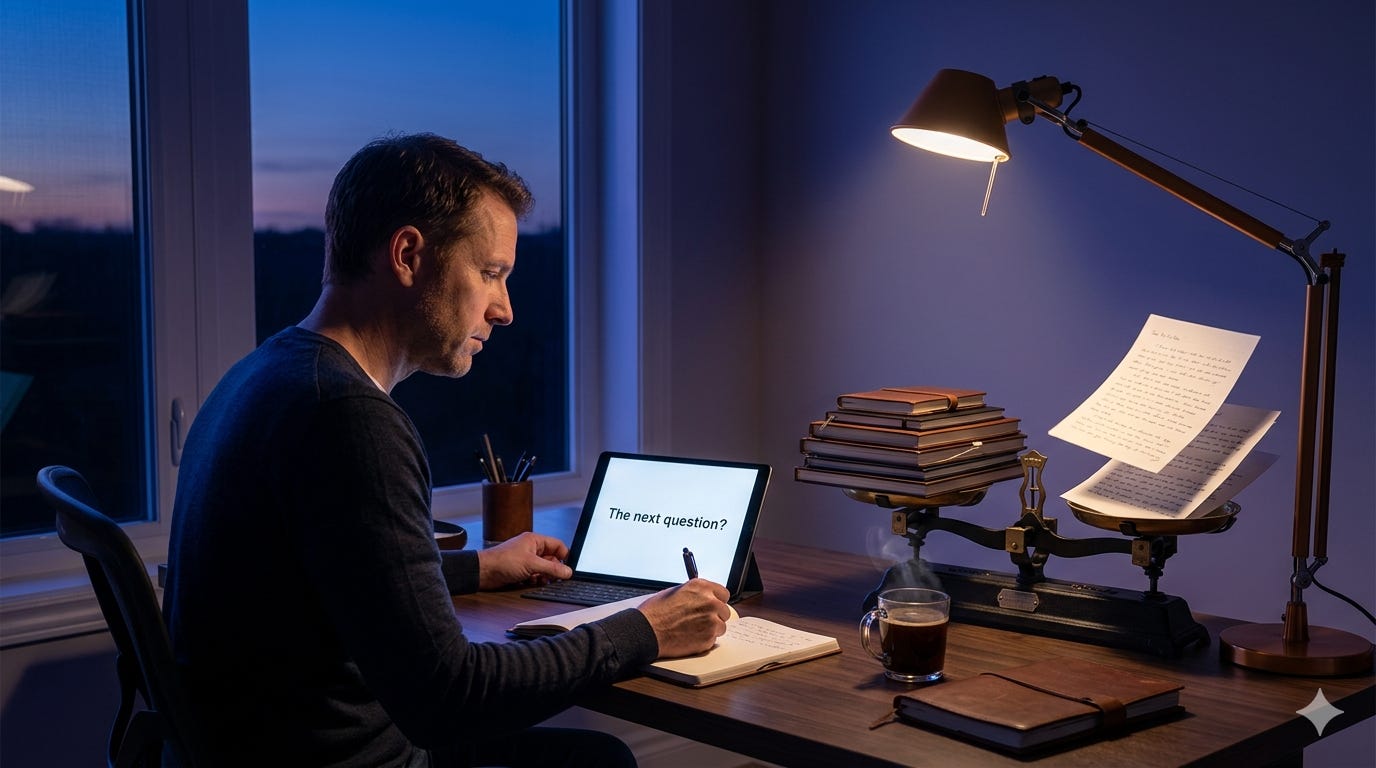
Peter Drucker said, “What gets measured gets managed.”
A scale out of balance isn’t measuring anything.
Not broken. Just out of balance.
That’s what stuck feels like.
The investment was real. The returns were private. I was becoming someone, slowly, through all of it.
And then, almost without noticing, I started handing pieces of it to the people around me. A friend who, months later, reflected back to me, “I remember when you said that. It changed the way I think.” My oldest son, who now says “control the controllables,” like he invented it.
The relay had begun. Experience it. Test it on yourself. Pass it on.
Then a question.
How many people like them will I never be in the same room with?
The people I turned to for fifteen years did the same thing for me. The names are numerous. Among them is Ryan Holiday. Jocko Willink. Todd Henry. Tim Ferriss. Brian Johnson. They were in a line. They showed up. They shared what they were learning. They made themselves findable. And when I needed them, I found them.
That question is why I’m here. That question is why any of this matters.
For years, I wanted to do the same thing. Sit down. Face the page. Write until something true appears. Add my voice to the line.
The problem was that the page never cooperated. Steven Pressfield named that feeling Resistance with a capital R.
The force that stands between the life you live and the unlived life within you.
You can’t see it. You can’t touch it. But you have felt it.
That radiating heat coming off a blank document.
Pressfield’s rule of thumb: the more important the work is to your evolution, the stronger the Resistance.
Pushing against Resistance is the wrong move, or so I thought. Ask any physicist. Force meets an equal and opposite force. The wall doesn’t move. You exhaust yourself trying.
But I’m not going to argue with Steven Pressfield.
The push matters. It’s what gets you to the chair. It’s what kept me coming back every morning for fifteen years when nobody was watching, and nothing was coming out. The push is the discipline. Without it, there is no 5 AM.
What I discovered is that the push alone isn’t enough. At some point, you have to change direction. Not abandon the effort. Redirect it.
What if instead of pushing thoughts onto the page, you let them be pulled out of you?
Not by more effort. Not by sitting longer or trying harder. But by the discipline to be willing to question yourself. To show up as the interviewee. To let the question do the work the blank page never could.
The interview does what a blank page never could. The blank page asks nothing. An interview asks everything. And somewhere in the answering, somewhere in the process of responding to a question you didn’t even realize you had, the thought that was stuck finds its way out.
The scale slowly finds balance.
At 5 AM, when the world is asleep, and there is no one to think with, I found something that asks the next question anyway. For me, that changed everything.
I write to know what I think. But I speak to understand what I think. That distinction took me fifteen years to find.
There is a difference between the interviewer and the interviewee. One pushes. The other is pulled.
And what emerges from that pull, in the quiet of 5 AM, is something that all those years of pushing never quite reached.
I am trying to take my place in that line. For the person sitting somewhere right now at whatever their version of 5 AM is, wondering if they are alone in this. Wondering if what they know is worth sharing.
You are not alone. And yes, it is.
This was never the 5 AM problem. It was always the 5 AM solution.