

Sunday night, Derek called from school.
He was working on an assignment and was trying something he’d heard me describe at dinner the night before.
Take the first AI’s answer to a second model. Push on it. Find where the two disagree.
I was taken aback. I’d been talking at that table for the better part of an hour, and none of it was aimed at him.
It wasn’t a conversation with him.
Back up a night.
My father and I were traveling west to Happy Valley. For the first leg, we had the car to ourselves.
Somewhere along the way, he asked how work was going. He knows it’s a subject I don’t usually open up about.
This time I did. I told him how I’ve started bringing AI into my job, and how it’s starting to change the way the days feel.
Just the two of us.
We picked Derek up from school on the way.
That night we had dinner with a friend of my father’s who is still a professor at Penn State. Five of us at the table.
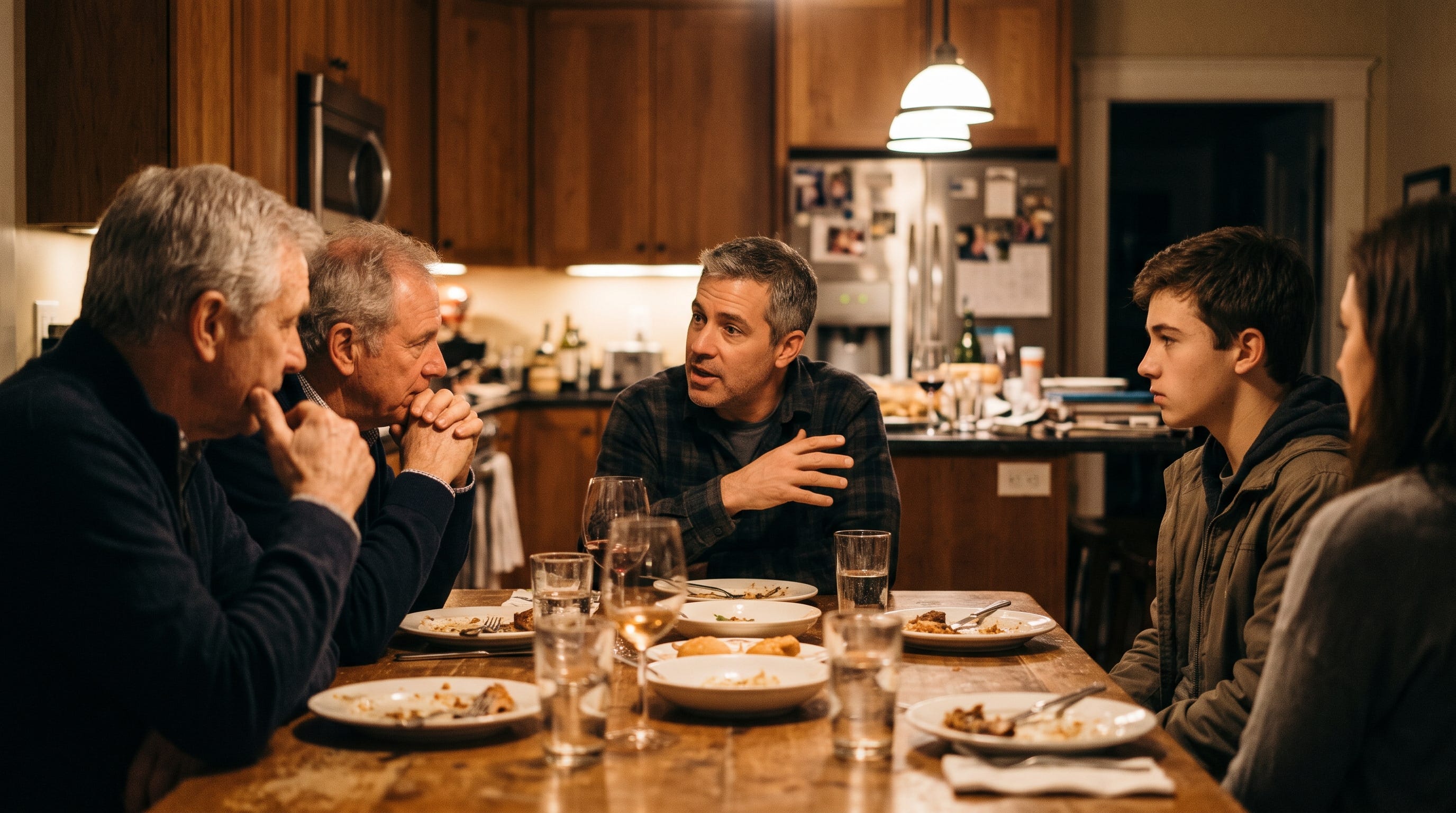
My father’s friend asked the same question. How’s work?
For men of their generation, it’s the first question at any table.
To me it’s always landed like “How’s the weather?”
That probably says more about me than the question.
I gave him a shrug.
For years, that’s been my answer, because the job has been the same conversations and the same problems, solved the same way.
My father wasn’t having it. “Tell him about the AI stuff at work.”
So I turned to my left and told him.
He talked about how he encourages his students to use AI.
I talked about how I use it.
A year ago, one model’s answer was the answer. Now I hand it to a second model and ask where they agree, where they split, and why.
I’m hunting for the objection that survives.
Then it comes back to me.
The machine makes it legible. I decide what it means.
Derek sat across the table, to my right. My whole body was pointed the other way.
For months I’ve worked out what I think on a screen. That night I said it out loud, in real time, and it pulled me all the way in.
Somewhere in the middle, I forgot he was there.
Practicing something is one thing. Writing about it is another. Explaining it to someone across the table is a third.
Finding out someone else was listening is the one you never plan for.
You choose who you’re talking to. You don’t choose who’s listening.
You don’t choose what they do with it, either.
Derek did that part himself. He heard an idea that wasn’t offered to him, decided it fit his problem, and tried it the next day.
When he hit a wall, he called. I walked him through giving the second model the same context he’d given the first before asking it to push back.
How the assignment turned out, I don’t know yet.
Some mornings I wonder what it's all for.
Why I’m up early, examining these thoughts, asking these questions, building these structures, trying these practices.
Part of it is mine. The striving to become the best version of myself.
Derek calls me with questions of all shapes and sizes. Most of them I see coming.
This one I didn’t.
I didn’t realize he was paying attention. And I’ve probably said it before: they’re always paying attention.
I believed it.
I still didn’t see it coming.
Last month I wrote about trying to hand my other son a rule and feeling the words catch.
This time I never said a word to Derek.
Then the question turned around on me.
How many times have I been Derek?
A podcast is made to be shared. That’s the point of it. But the best ones feel like sitting in on a private conversation. Two people at a table, and me off to the side with earbuds in, taking what fits my life.
My library holds thousands of those moments.
The writers I quote weren’t writing specifically for me.
Jocko Willink has a line for the listener. Listen, he says, and let what you hear “become part of who you are.”
Someone is at your table right now, listening while you talk to someone else.
You won’t know what they take home.
You’ll find out when one of them calls.
Bravo. Bravo.