

I knew the answer before I finished reading the question.
Then I spent a week digging underneath it.
The question came from day one of Dan Koe’s 30-Day Creator Sprint.
Who has shaped your thinking?
Two names landed instantly.
Tim Ferriss. Brian Johnson.
I wanted to see who else was in there.
So I went through everything I’d saved. Over twenty thousand highlights. Nearly four years of journal entries. Every YouTube video I’ve watched since 2013.
Day one of a thirty-day course. An exercise scheduled for one day consumed one week.
The digging led me back to my own words.
Fourteen months earlier, I had written a journal entry titled “My Mount Rushmore of Influence.”
Ferriss and Johnson, etched in the stone.
Todd Henry, slowly being added. A note to myself: consider who else deserves a spot.
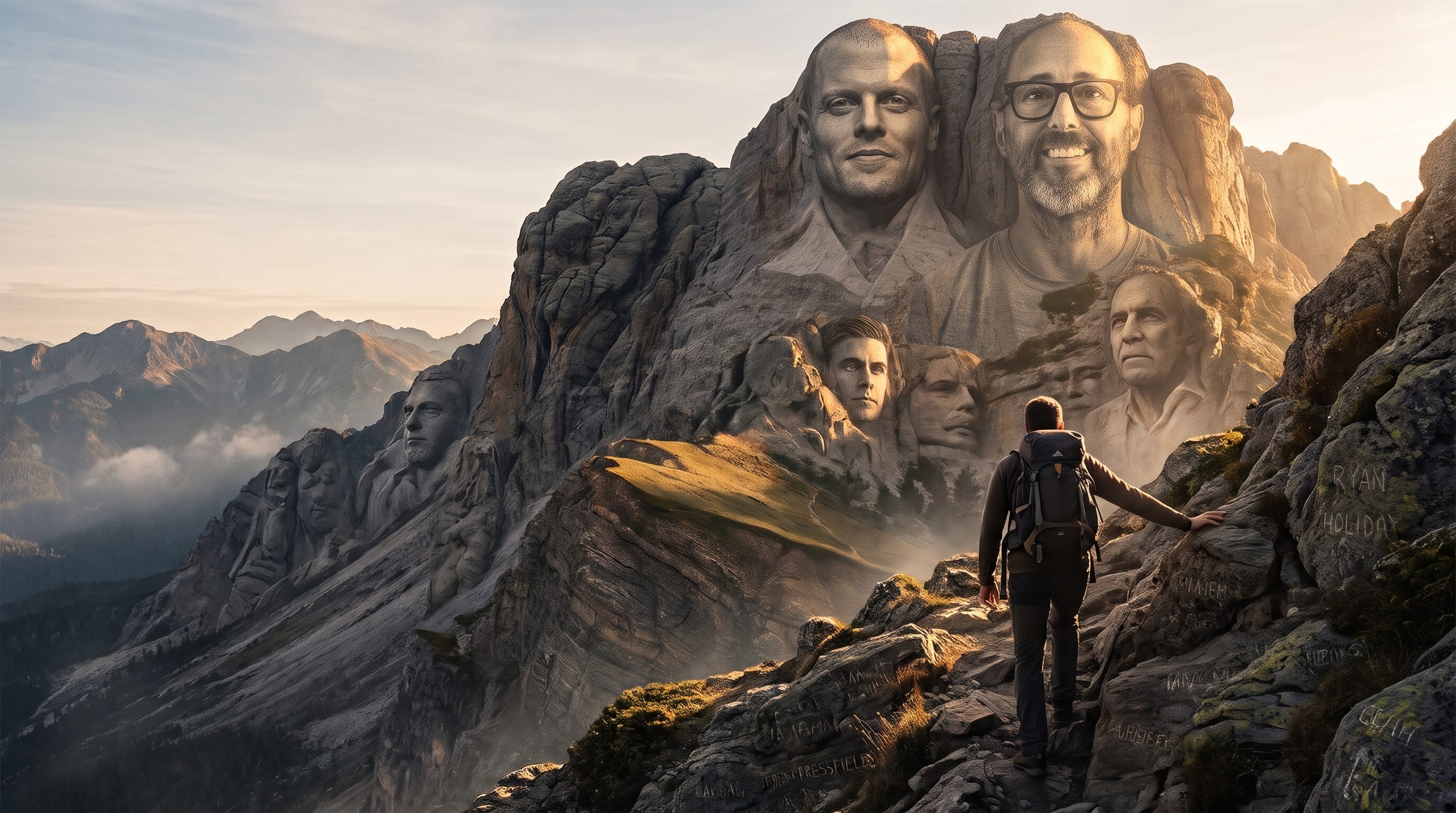
This past February, I tried to carve Dan Koe in next to them.
The idea has a lineage, of course. Brian Johnson keeps a wall of heroes in his office, and in Areté he asks it plainly: “Who inspires YOU?”
Somewhere along the way, his wall became my mountain.
I was building a monument.
The digging showed me I’d been asking it the wrong question.
Carving a face into stone takes a choice.
Ferriss and Johnson are carved up top, and they’ve earned it. Their faces are at the peak. Their stone runs all the way to the bottom. They’re the foundation the rest was built on.
The rest of the mass is my mountain of influence. Everyone else lives there, and names rise when the work calls.
When I’m wrestling with fear and the urge to wait, Steven Pressfield and Phil Stutz come forward. One calls it Resistance. The other calls it Part X.
When I need steadiness, I turn to Ryan Holiday and the Stoics.
When the problem is the creative work itself, I turn to Todd Henry.
When I’m building something of my own, I turn to Dan Koe.
When it’s the system holding everything together, Tiago Forte.
Then the question changes, and they settle back into the stone.
The faces stay fixed. The light moves. Which part of the mountain catches it depends on the hour, and on what I’m working through.
I could keep going. The integrity in me wants to name every one of them. Past a certain point, though, the list stops being credit. It turns into name-dropping.
That’s what the week bought me. The answer stayed the same.
Now I can see what it’s standing on.
I care about attribution.
Deeply.
When an idea moves me, I want to know where it came from and credit the person who planted it.
This week I even went looking for the source of my own Mount Rushmore. The frame itself is borrowed. Sports fans have argued for decades over who belongs on one. The mountain underneath the faces, and everyone living in it, is the part I can claim.
Caring where ideas come from is integrity. I believe that.
It also has a shadow.
Giving credit and seeking permission can look the same. Credit points outward, toward the person who taught you. Permission points inward, toward a slip you’re waiting for someone else to sign.
This week, I was digging for credit. It was a way of acknowledging the people who shaped me, and it felt like the real work.
There were years when it was permission.
For at least five of them, I said I’d write before I actually did. Attribution was one reason among several.
It was the most respectable one.
Thirty-four weeks of publishing later, the shadow has moved. Starting is behind me.
The risk now is that research will stand in for a decision about what this work becomes.
Austin Kleon puts it simply in Show Your Work: “Your influences are all worth sharing because they clue people in to who you are and what you do.”
Naming the mountain is part of the work. It was never meant to replace it.
So here’s the test I’m keeping.
When I go looking, does it point outward, toward the people who shaped me, or inward, toward a permission I’m still waiting on?
The faces at the top are settled. The mountain underneath keeps growing. New names will find their way into it, and each one becomes another handhold.
The work is the climb. It always was.
Brian Johnson once shared a story about a climber who reached a great summit. What stayed with the climber was the view from the top: every other mountain, still waiting.
I’m still climbing this one. I’m starting to wonder what I’ll see from the top, and which of those mountains are mine to climb.
Who’s in your foundation?
And when you go back through the rest of your mountain, is it credit or permission?