

Have you ever stopped mid-thought and wondered not what you were thinking, but how?
Most people don’t. The mind just runs. You follow it.
For fifty years, I followed mine without understanding it. Pattern recognition, rabbit holes, half-finished things, sudden bursts of unstoppable focus. I called it personality. I called it quirk.
Mostly I called it a problem.
It wasn’t until recently that it started to make sense.
There’s a story about two fish swimming along when an older fish passes going the other way. The older fish nods and says, “Morning. How’s the water?”
The two young fish swim on. After a while, one looks at the other and asks: “What the hell is water?”
David Foster Wallace told that story in a 2005 commencement address. His point was about awareness. The most important realities are often the hardest to see, because they’ve always been there.
I’ve been in the water my whole life. I just didn’t know it was water.
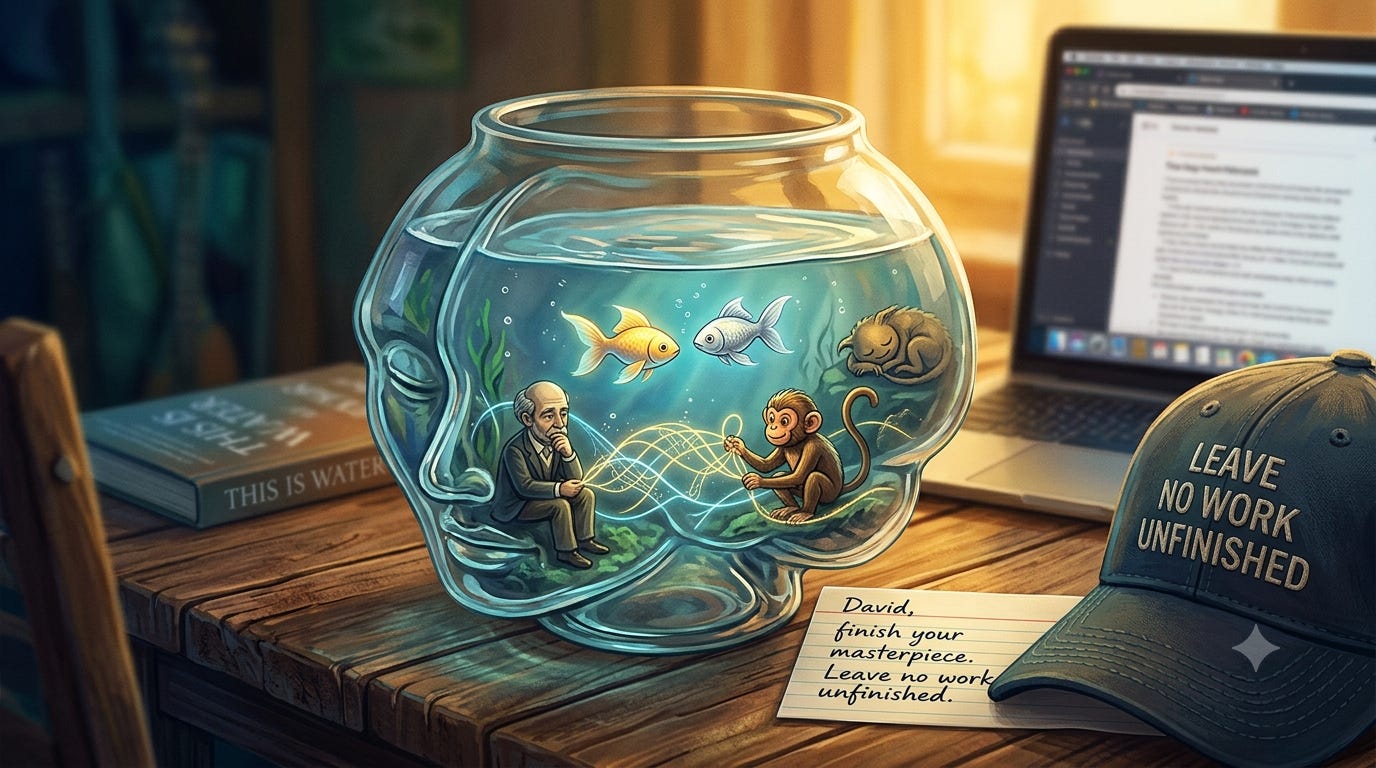
Some things hide in plain sight. This was one of them.
Here’s what I know about my mind.
There are two parts. One knows what matters. It knows what needs to happen, where the attention should go, what the priority is. It’s reasonable. Rational. It has a plan.
The other part is interested in everything else.
Not occasionally. Not when things get boring. Constantly. Always. The second part doesn’t care about the plan. It cares about what’s alive right now, what’s interesting, what just caught its attention from three tabs over.
These two parts have been fighting for the wheel my entire life.
The distracted part wins most of the battles.
That’s not a confession. That’s the truth.
Tim Urban wrote about this in 2013. He called it the procrastinator’s brain.
Inside it lives a Rational Decision-Maker and an Instant Gratification Monkey.
The monkey lives only in the present. Ignores the past. Ignores the future. Cares only about what feels good right now.
The Rational Decision-Maker knows exactly what should happen. But he wasn’t trained to fight a monkey. So the monkey drives.
And the Rational Decision-Maker sits in the passenger seat, feeling worse about himself every mile.
There’s a third character. The Panic Monster. It sleeps until a deadline gets close enough to bite. When it wakes up, it’s the only thing in that mind the monkey actually fears.
Control snaps back to the rational side instantly. Not through skill. Through chaos.
Urban called the whole thing procrastination.
I’m not sure that’s wrong. I’m not sure it matters.
What I know is that when I first met those three characters, something landed.
Not a new idea. A recognition. The feeling of someone describing your inner life more accurately than you ever have.
I thought it was just me.
That’s the loneliness underneath all of it.
When the mind works differently, and nobody names it, you assume the difference is the problem.
Lack of discipline. Poor follow-through. A character flaw that just needs more willpower.
It isn’t a flaw. It’s how some minds are built.
Jesse J Anderson, in his book “Extra Focus: The Quick Start Guide to Adult ADHD,” reframed it precisely. Not a deficit of attention. The opposite. An abundance of it. Everything shouting at once. A dysregulation, not a deficiency. The fire hose with no fire to point it at.
When I read that, something moved. Not new information. The right frame for something I’d carried for fifty years without knowing its shape.
That’s what a perspective shift does. It doesn’t change the facts. It changes what the facts mean.
I don’t have a clinical diagnosis. I’m not chasing one. But I can’t ignore what the evidence keeps pointing at.
Every system I’ve ever built, GTD included, exists because advice built for neurotypical minds didn’t work for this one.
Not sometimes. Consistently. That advice is built for an importance-based nervous system. Do the hardest thing first. Prioritize by value. Focus on what matters most.
A neurodivergent mind doesn’t refuse those instructions.
It just can’t run on them. The effort was always disproportionate to the outcome. Not because the work wasn’t done. Because the framework was mismatched to the mind using it.
This mind moves toward interest. Toward novelty. Toward what’s alive. And for fifty years, I called that a flaw.
It isn’t a flaw. It’s the hardware I’ve always had. Everything I’ve built since is software written to run on it.
Not ambition. Adaptation.
I built the structure before I understood why I needed it.
A system to manage my attention. A way of running my own life like something with departments and a chain of command. I didn’t know yet that I was building scaffolding for a mind that had never been properly named.
If you’ve been here before, you’ve already seen pieces of that structure. This is the part I hadn’t shown you: why it had to exist in the first place.
The solution came before the problem had a name. Built in the wrong order, on purpose, even if I didn’t know it at the time.
The same mind that found Urban, found Anderson, found Wallace, found this page you’re reading right now. Not through discipline. Through an open tab, an unexpected rabbit hole, a thread followed sideways until it landed somewhere it mattered.
That’s how this mind works. The monkey Urban named, the one chasing what’s alive instead of what’s important, is also why any of this got found.
Not the villain. Not the hero. The mechanism.
This mind didn’t start working this way. It’s always worked this way.
The recognition is what’s new.
Somewhere in the accumulation of voices arriving sideways, the picture became undeniable.
Urban. Anderson. Wallace. Each one a fish swimming past, saying How’s the water?”
You’re not broken. You’re not undisciplined. You’re not alone in this.
You’ve just been swimming in water you didn’t know had a name.
Now that you know what you’re swimming in, something shifts. Not fixed. Not solved. Reoriented. The relationship to the mind changes when the mind finally makes sense.
On my desk there’s an index card. It came free with a box of protein bars. The company is called David.
It says: David, Finish your masterpiece
The hat that came with it says: Leave no work unfinished.
They were talking about eating clean.
This is about thinking clean.
Now the work begins.
What becomes possible when you stop fighting how you’re built and start working with it instead?