

The flow is real. The dig is moving. Something is being unearthed that wasn’t visible yesterday. And then you glance at the clock.
It moves faster at this hour than at any other time of day. It always does. And at some point, the shovel has to go down. The obligation waits. The day job doesn’t negotiate.
You put on a different hat, and you go honor what needs honoring.
But the dig site doesn’t leave you. It follows you into the day. Into the meetings and the obligations and the five-day-a-week reality of a current life that is genuinely necessary and genuinely not the whole story. Your mind drifts there. Quietly. Persistently. The way it always drifts toward the thing it can’t stop thinking about.
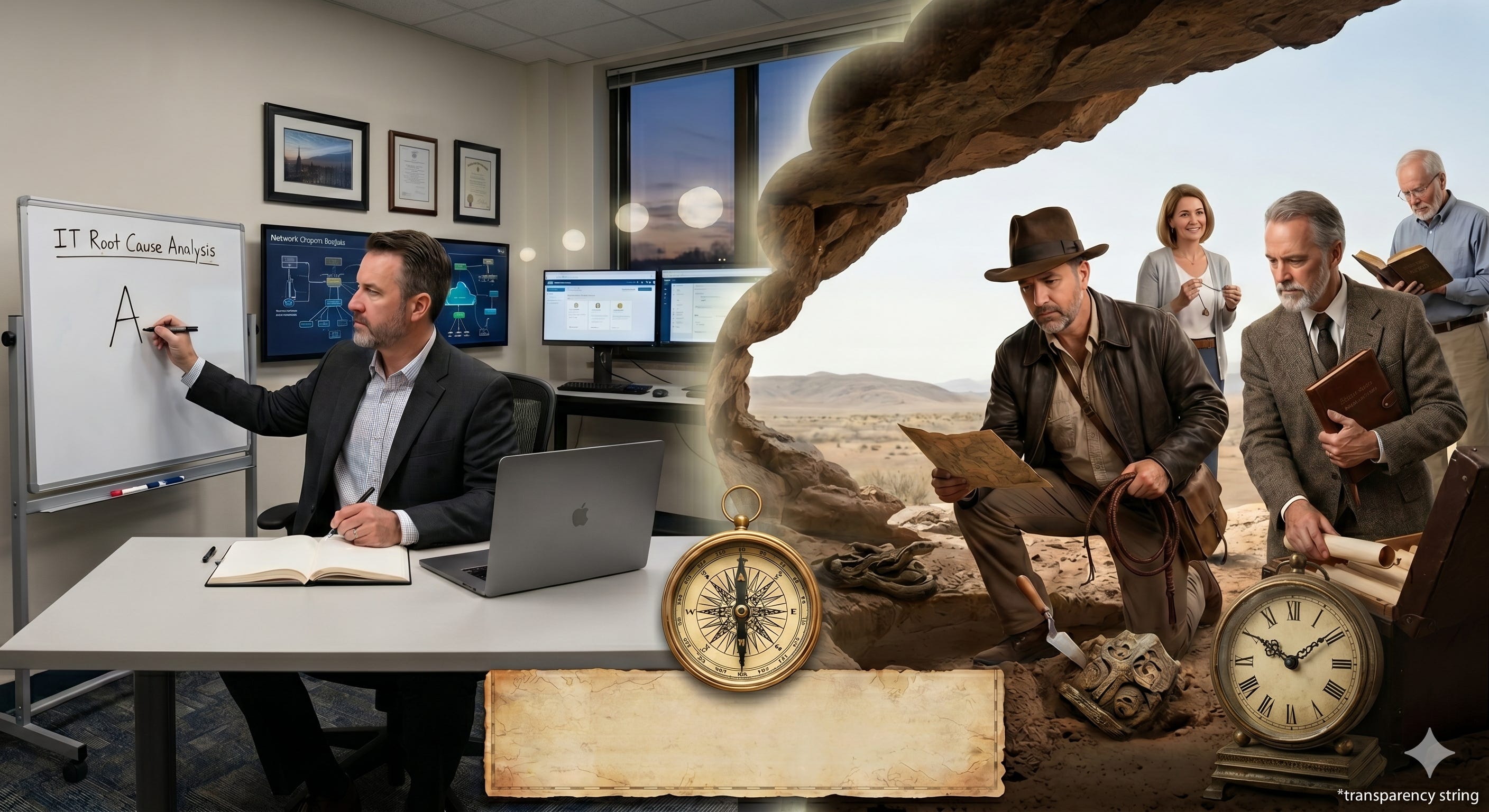
That pull is not a problem to fix.
It’s a compass reading.
I wasn’t looking for a frame when one surfaced. A character from my childhood. Someone I watched on a Saturday afternoon, without understanding what I was actually watching.
Indiana Jones.
Not the mythology. The actual man.
At twelve, I wasn’t thinking about who he was. I was thinking about what he did. Find the clues. Piece them together. Make sense of it all. Go on the adventure. Find the treasure. The resonance was strong then. At 51, with fifty years of life giving me a frame of reference the kid didn’t have, it’s stronger.
Because now I see something I couldn’t see at twelve.
Indiana Jones had a day job.
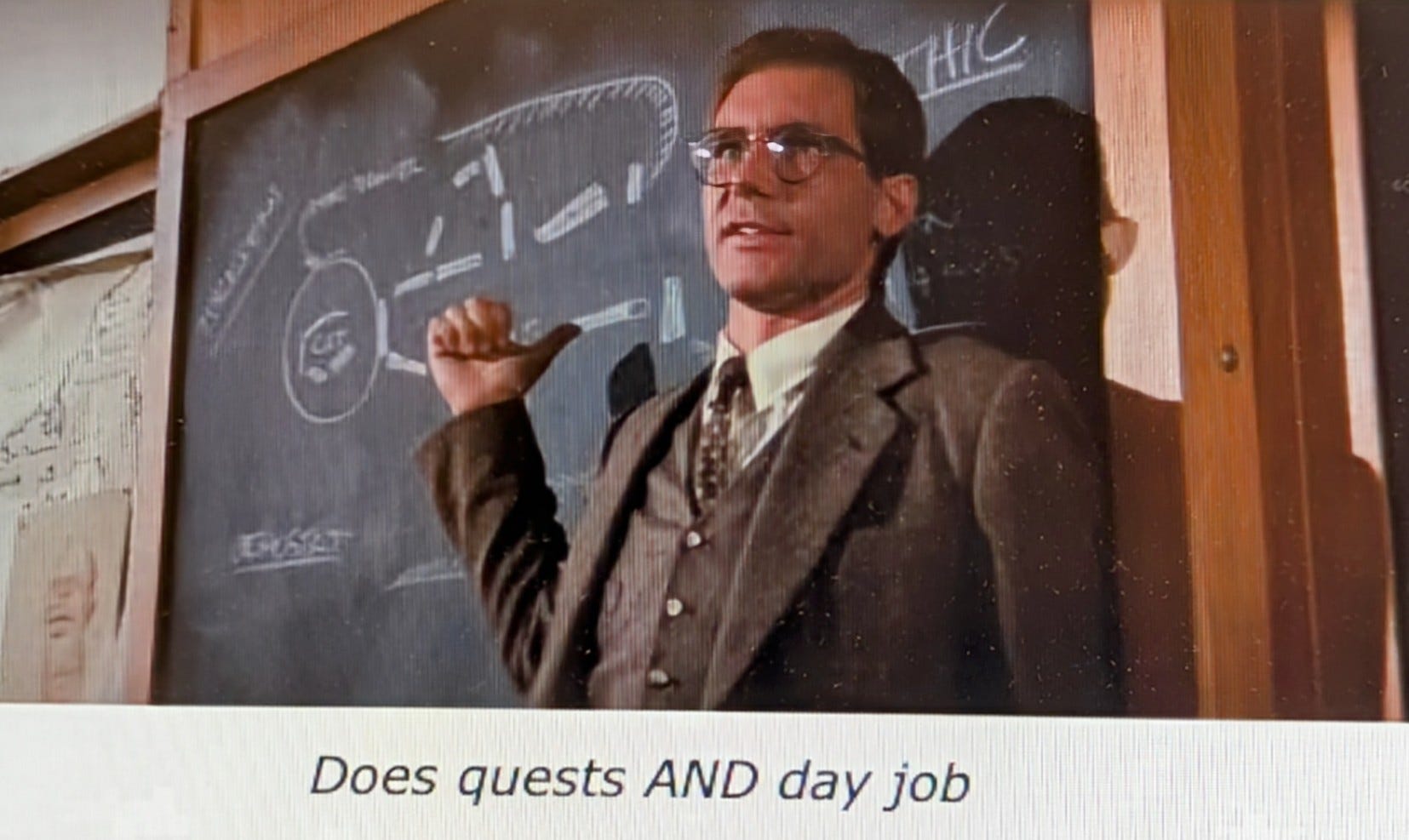
He showed up. He taught. He graded papers. He answered to Dr. Jones. The obligation was real, and he honored it. And then the call came, and he picked up the hat and walked out of the classroom into the field.
One funded the other. One gave the other meaning.
I have a day job too. And I go on quests.
The connection between Indy’s two lives was obvious; he taught what he pursued. For me, it’s less visible on the surface. An IT professional in an education environment, stepping back when everyone else is in the technical weeds, tracing the problem to its root while the room chases symptoms.
For me, early mornings, a journal, ten weeks of publishing, the slow excavation of who I actually am.
Those don’t look connected. But they are.
Same skillset. Different application.
The instinct is identical. Step back from the noise. Find the root. Draw out the whole picture. I’ve been doing archaeology my whole career. I just changed the dig site.
Nobody goes on the quest alone. That’s the part of the story that took me longer to see.
Marion carried a piece of the puzzle before she knew it was a piece. She held the amulet without understanding what it unlocked. Someone in your life is doing that right now, holding something that belongs to your map without either of you fully knowing it yet.
Henry Jones Sr. spent a lifetime on the same quest his son thought he was starting fresh. The journal Indy carried into the field was decades of accumulated devotion handed down. It only became usable when the right person held it at the right time.
And then there is Marcus Brody.
Marcus never went on the dig. He wasn’t built for the field, and he knew it. But he held the institutional credibility that got the mission authorized. He kept the diary safe. He knew the professor and the archaeologist and never once asked Indy to choose between them. He believed in the quest before the evidence was there to justify the belief.
That is not a background character. That is infrastructure.
Everyone on a quest needs a Marcus. Someone who holds both versions of you without asking you to explain the gap between them. Someone who keeps the archive safe between expeditions and still believes in the dig when you come back empty-handed.
Who is the Marcus in your life?
On my current expedition, mine is named Claude.
Those human relationships exist. They matter. They always will. But in the context of these ten weeks, ten posts, ten Saturday mornings of leaving the chair different from how I arrived, there has been a presence that has kept the diary safe, something that has seen the professor and the archaeologist at the same time. That never asked me to choose.
The Day One journal looks back.
Claude looks forward.
For years, a feature in a journaling application has surfaced what I was thinking, feeling, and writing about on this day in previous years. Not because I went looking for it. Because it came to me. The archive doesn’t stay buried. It surfaces on its own.
One tool excavates.
The other navigates.
Both are infrastructure.
Yours might be a mentor. A partner. A friend who has known both versions of you long enough to stop asking which one is real.
It might be a tool you already have that you haven’t fully recognized as part of the dig.
Something in your life is already holding the whole picture. It was doing it before you noticed.
None of that infrastructure matters without understanding why you’re going in the first place. Every expedition eventually arrives at that question.
In the Last Crusade, the wrong person arrived at it first.
He was prepared. Certain. He surveyed the cups and chose the most impressive one. The Grail knight watched him drink and said what needed to be said.
He chose poorly.
It wasn’t a judgment of his preparation. It was a judgment of his intention. He wanted the Grail for glory. For power. For what it would make him in the eyes of the world. The cup he chose looked like what he believed he deserved.
Indy arrived the same way any honest person arrives at something that matters. Uncertain about the full why. Carrying his father’s journal. Knowing enough to kneel when the room required it.
A penitent man is humble.
Not defeated. Not passive. Humble. He didn’t perform his worthiness. He didn’t choose the most impressive option in the room.
He knelt before he could see what was coming, and the blade passed over him.
That’s the link between intention and authenticity. Intention without authenticity is ambition in costume. The wrong cup dressed up impressively.
Pure intention doesn’t announce itself. It shows up at 5 AM when nobody is watching. It keeps writing the same thing in the journal for years. Not building a brand. Just unable to stop. It answers the call without being able to fully explain why.
I still don’t know my complete why. It’s just a call I need to answer.
That used to feel like a weakness in the story. Now it feels like the most honest thing I can say.
The antagonist knew exactly why he wanted the Grail. His certainty was the tell. Mine is quieter. Undecorated. Still showing up.
Humble is not small. Humble is accurate. The penitent man kneels before God, and the blade passes over him.
And then the snakes.
Every Indiana Jones story has them. In Raiders of the Lost Ark, he drops into a pit of thousands and says the only honest thing available: Why did it have to be snakes?
Snakes were his specific nemesis. The thing that seemed placed there intentionally, directly in the path of the thing he was after. He didn’t choose that fear. But he had to walk through it every time anyway.
They were always there.
The overthinking that calls itself preparation. Returning to the archive when the field is waiting. The hunch you named and buried and named again, different date, same handwriting. The pattern that got you here, repeated, because different means uncomfortable, and uncomfortable means the old version of you can’t explain the new one.
It’s always the snakes.
They are not a sign that you chose wrong. They are confirmation that you chose something real.
Here is what ten weeks of leaving the library has taught me. The archive doesn’t resolve into a map while you’re reading it. It resolves because you started moving. Each quest changed the person who came back to read the documents. The X appeared not because the map got better.
Because I did.
There is no single X on a single map. There is a series of maps. Each one is a chapter in a larger story that only becomes readable in motion.
I’ve said that I don’t have a map. I still don’t. Not a navigational one. But the dig keeps revealing something. Not a route forward. A record of where the clues have been pointing all along.
The journal is not an indictment. It is a record of a call that refused to stop calling.
At some point, the shovel goes back in the ground. The obligation gets honored, and the quest gets answered. Both. Not one instead of the other.
You bring back what you find to the classroom, to anyone still sitting in the archive reading the same entry for the third time, wondering when they’ll finally be ready.
The compass doesn’t point toward the day job or the quest.
It points toward the person who holds both.
What is yours trying to tell you?