

Debarrass
4:34 this morning. Same hour I’ve kept for years, except this week it stopped feeling like a habit and started feeling like a test.
Eyes open, and they’re both already there, urgent and important, pulling before I’m even all the way out of bed.
Cave to the loud one before I’m fully awake, and today’s order is already gone, handed over before the coffee’s even started.
Tomorrow gets its own shot. Today doesn’t get a second one.
Marcus Aurelius knew something about this too, if you can believe it. The Emperor of Rome, the most powerful man alive, and he still wrote himself a note most mornings, reminding himself why he was getting up at all: I have to go to work, as a human being.
But the pull he was fighting at dawn two thousand years ago hasn’t gone anywhere. It’s the same one waiting for me the second my feet hit the floor.
Strange, coming from a guy who ran an empire.
Mine’s smaller. A house instead of Rome, an inbox instead of a Senate.
Recently, I wrote that I didn’t yet know if this was the same kind of fall.
I still don’t.
But there’s a hallway between not knowing and finding out, and I know this one well.
I walk it every morning before anything else happens, before the house wakes up, before the job remembers I exist.
Gary Keller names the actual trick: once everything feels urgent and important, everything starts to look equal.
The whole mechanism, not a flaw in judgment. No real decision left, just noise to react to.
Twenty years of always-on IT work built the wiring that makes the trick work on me specifically. Every alert used to mean something was actually broken.
My nervous system learned that lesson well, still treats every ping like a threat.
That is a part of the blur.
The trained reactive mind.
Seneca named this two thousand years before notifications existed, with more precision than most manage today: don’t let the inbox run the day, don’t mistake distraction for rest; know what’s meaningful from what’s obligation; essential from inessential.
None of that’s new information.
I’ve had that exact passage sitting in a journal entry for two years.
Knowing it and living inside a nervous system trained to ignore it are two different problems.
Here’s what actually breaks the trick: one question that neither voice gets to skip.
What is the desired outcome?
Ask it the size of the whole year, and it’s too heavy to lift.
Ask it the size of the next ten minutes, and it fits in one hand.
Same question, different weights.
Turns out to be the only one that actually matters.
Halfway down the hallway, there’s a bar across it. There has been for a while.
I didn’t have a word for it until Sunday, when one showed up on its own.
Debarrass.
To remove what impedes. To take away what’s in the way.
Fine. Let’s find out what’s actually in the way.
This is the turn. Aurelius said it two thousand years ago.
The impediment to action advances action. What stands in the way becomes the way.
Through it. Not around it.
Urgent wants a reaction.
Important needs a response.
The whole distance between them is the length of one breath.
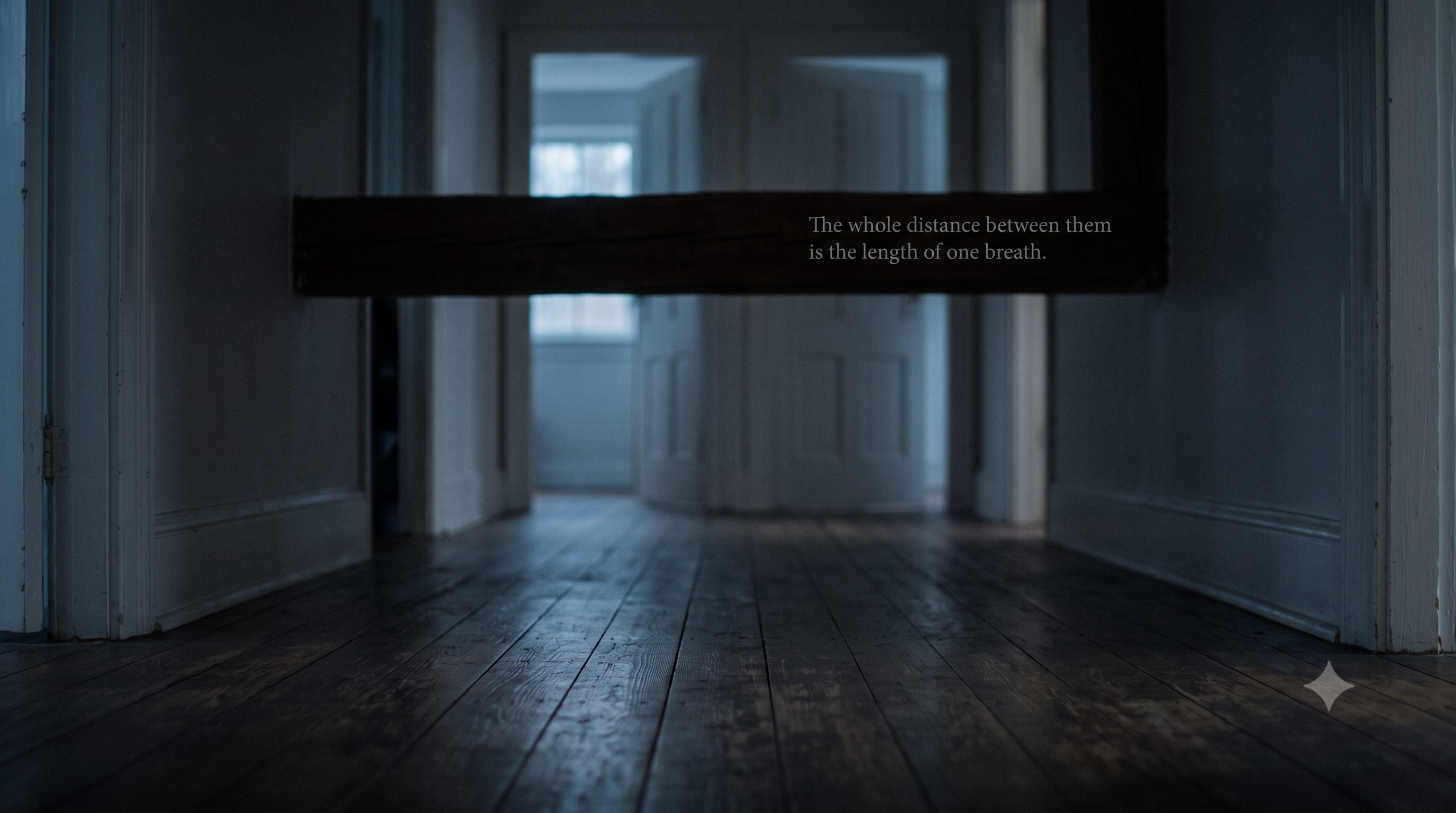
Reaction doesn’t ask permission. It’s already moving before the question’s finished.
Response takes that breath first, and something happens inside it: the bar comes down just long enough to see what’s actually behind it.
Debarrassed, the hallway opens back up, and at the end of it, there are two doors.
There always have been.
Urgent’s already shouting an answer before the question’s even been asked.
Important just waits, wondering if you’ll ever ask at all.
For once, standing here, breath already taken, the choice isn’t hard to see.
It’s just hard to know if it’ll hold past the doorway.