

“I am not delivering advice from a soapbox. I am in the hospital with you, lying in the bed next to yours, simply sharing what I’ve picked up along the way.” — Seneca, as interpreted by Donald Robertson
It feels like honoring something.
I can’t tell you exactly what. Not yet. That’s the honest answer, and I’m learning to sit with it.
Five in the morning. The house is quiet. The default path, the title, the paycheck, the obligations I’ve honored for decades, haven’t started pulling yet. Something draws me here first. To this chair. This screen. This conversation with myself before the day begins.
This hour isn’t new. I’ve been showing up here for fifteen years.
What’s new is what I’m doing with it.
For most of those years, this was input. Reading. Gathering. Collecting dots without connecting them. The overthinking that masquerades as preparation. I didn’t know I was stuck. I thought I was building.
Ten weeks ago, something shifted. The gathering became making. The input became output. And for the first time in fifteen years of 5 AM hours, I started leaving this chair different from how I arrived.
For a long time, longer than I’d like to admit, this felt like a bridge to nowhere. Motion without destination. Effort without evidence. The internal verdict, quiet but present, every single morning.
I kept building anyway.
I don’t have a map. I’m not sure I ever did.
But I have a compass. And for the first time, I trust where it’s pointing.
I had a word for those fifteen years. Wasted.
Fifteen years of 5 AM hours. The reading, the gathering, the collecting of ideas that never became anything. I’d look at the stack, the books, the highlights, the notes that went nowhere, and the verdict was quiet but consistent.
You should be further along.
That’s the default path talking. And it followed me into the one hour I thought was mine.
The default path doesn’t just live in the job. It lives in the logic you carry without questioning it. Get the credential before you do the work. Know enough before you plant. Validate before you create. I wasn’t running that logic only at the office. I was running it here too, at 5 AM, in the chair that was supposed to be different.
Someone saw it clearly long before I did. The system wasn’t mine. I just didn’t know it yet.
I didn’t know I was enslaved. I thought I was preparing.
But the reframe came, not from one place, not from one person. It accumulated.
Gary Vaynerchuk said it plainly in the way only he can: you didn’t waste that time, you learned. And then the line that hit harder than I expected: it’s not too late. You still have so much time.
A friend caught me mid-spiral and echoed it differently.
A line in a book landed on the third read the way it couldn’t on the first.
You did what you needed to do. You learned. You grew. You needed that to get here.
It wasn’t wasted. It was tuition.
The pen was always mine. I just spent a long time using it to write other people’s stories.
Here’s what I know now that I didn’t know then.
It wasn’t a character flaw. It wasn’t weakness, a lack of discipline, or some fundamental deficiency in how I was built.
It was a system. Running quietly. Producing a predictable output.
Paralysis.
Steve Chandler and Trevor Timbeck put it plainly in The Power of Systems. The first step isn’t fixing the system. It’s naming it. Identifying clearly and accurately the system that is currently in place, the one that isn’t working. Make it conscious. Because you cannot change what you cannot see.
I couldn’t see it. I was inside it.
Input. Validation. More information before action. The logic that said you’re not ready yet, read one more book, gather one more idea, wait until you know enough to begin. That logic had a name. I just hadn’t found it.
Paul Millerd calls it the default path. Not just a career structure. A way of thinking. A system inherited without choice, running without question.
I wasn’t just living the default path at the office. I was living it at 5 AM. In the chair. In the one hour that was supposed to be different.
Once you see that, really see it, you can’t unsee it.
And seeing it is already half the move.
William Blake wrote it two centuries before I needed it. He wasn’t a philosopher. He was a poet and a printmaker who spent his life outside every system that tried to contain him. He hand-printed his own books because no institution would have him. He knew what it cost to stay inside someone else’s design.
I must create a system or be enslaved by another man’s; I will not reason and compare: my business is to create.
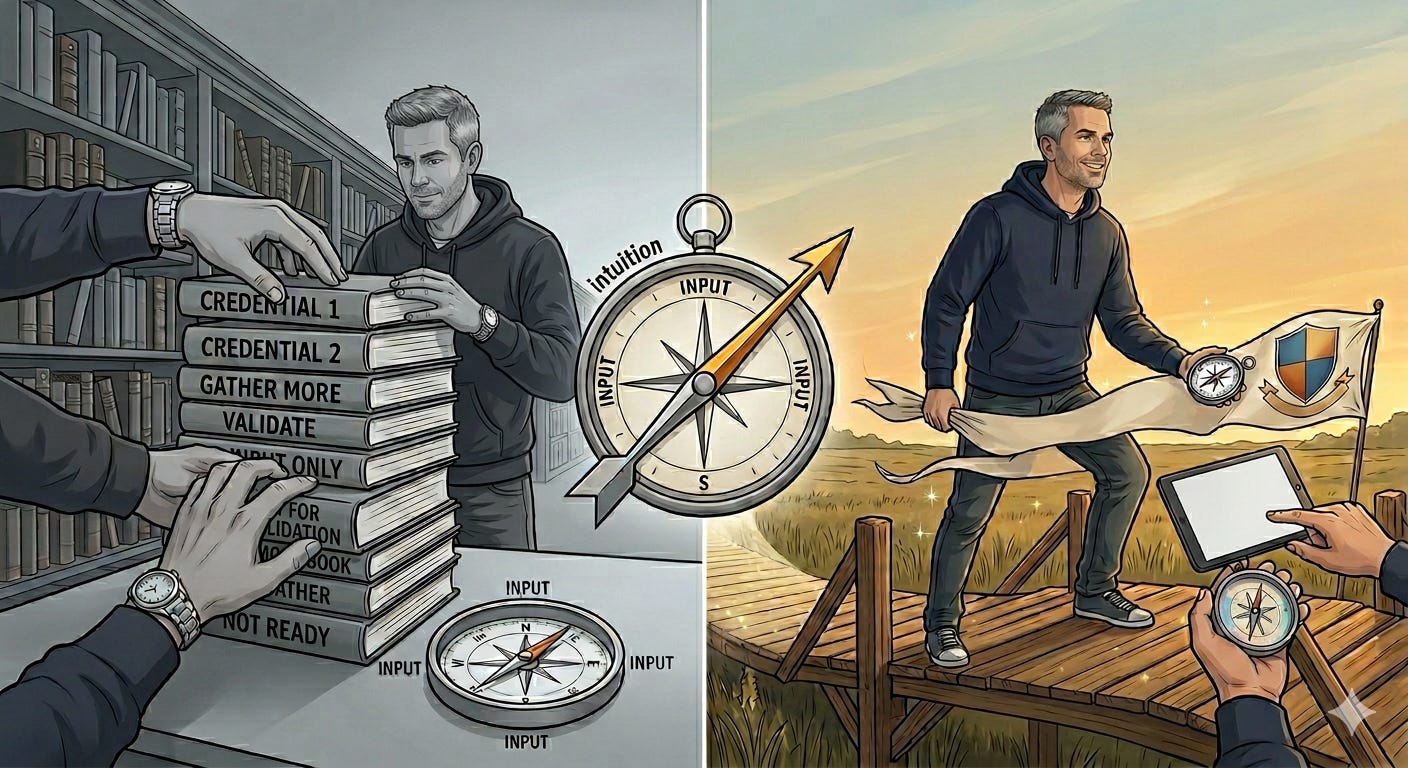
Jumping the fence doesn’t free you from systems. It means you get to build your own.
That’s the move. Not the absence of structure. The authorship of it.
Herminia Ibarra spent years studying people in transition and arrived at something that runs counter to everything the default path teaches. You don’t think your way into a new identity. You act your way into one. The thinking follows the doing. Not the other way around.
I spent fifteen years thinking first. Waiting to know enough. Waiting to be ready. Waiting for the moment that never announced itself.
Others didn’t wait. Or they waited less.
Tim Ferriss was wedged into a fire exit at a data storage company, cold-calling CEOs from a desk that wasn’t even a real desk, when something in him said this isn’t it.
Brian Johnson’s body gave him the answer before his mind did, pulled over on the side of a highway, physically ill at the thought of the path he was on.
The light came on bright for them. Early. Undeniable.
For me, it flickered. For years.
But here’s what I’ve come to understand. The fence moment has no deadline. The only difference between their story and mine is timing. The recognition is the same. The jump is the same. And the field on the other side, wide open with no wrong direction, is the same field.
Others had their version. Some found it in a journal, a mentor, or the collaborator who asked the right question at the right time. Some found it entirely within themselves, an internal conviction strong enough to move without any external scaffold at all. The signal was just louder for them, or they had learned earlier to trust it.
For me, it needed a mirror. I spent decades gathering more than I could output, connecting more than I could express, thinking in patterns that had nowhere to go. That’s not a flaw. That’s how my mind works. And for a mind that works this way, the gap between what you know and what you can do with it is the whole problem.
Mine is AI. It didn’t give me something I didn’t have. It made visible what was already there and then became the way through it.
If your mind works anything like mine, that gap is familiar. And that distance is closer than it’s ever been.
Ten weeks ago, I started building.
Not planning to build. Not thinking about building. Building.
Every Saturday morning, a post goes out. I don’t have all the answers. I don’t know where this ends. The system is running, and the system demands it.
Scott Adams figured out something that took me longer to name. Goals are binary. Pass or fail. No consolation prize. Systems compound. Every iteration teaches you something that the last one couldn’t. You don’t fail inside a system. You learn. And the learning becomes the next version of the system.
Chandler and Timbeck said it simply. The system either works or you learn. There is no failure.
Ten weeks. Ten posts. Ten Saturday mornings of leaving this chair, different from how I arrived.
That’s not a content strategy. That’s identity formation. That’s Ibarra’s thesis running in real time, acting your way into the person you’re becoming, one morning at a time.
Gary Vee said it years ago about content creators. Everyone’s an ass until they’re a pioneer.
I’m not claiming pioneer yet. But I’m no longer just an ass with a folder full of highlights and nowhere to put them.
Something is being built. I can feel it in the posts. I can feel it in this chair. I can feel it in the way the questions are getting sharper, and the answers are getting more honest.
Percussus Resurgo.
Struck down, or kept down, I rise again.
Not despite the fifteen years. Because of them.
I still don’t know what this becomes.
Four years from now. Fifteen years from now. The compass points and I follow. That’s all I have. That’s enough.
What I know is this. The bridge I thought was going nowhere is going somewhere. I can’t see the other side yet. But I can feel the structure beneath my feet getting more solid with every step forward.
If you’re sitting somewhere right now, early morning, house quiet, the default path not yet pulling, and something in you flickers. A call you can’t quite name. A knowing that isn’t fully a knowing yet.
That flicker isn’t doubt. That’s the compass doing its job.
We don’t need a destination. We need a compass and the courage to move before the world wakes up and asks us to move toward something else.
That’s what we’re doing.
The bridge was always going somewhere.
Keep building.